
THE BOTTOM LINE
Luck affects short-term results, but probability and expected value determine the direction of repeated play.
- House edge is the casino’s mathematical advantage, usually expressed as a percentage of total bets.
- A fair coin can land on the same side repeatedly, so a winning streak does not prove that the next result is more likely.
- At a 2% house edge, every $100 wagered carries an average expected loss of $2, before variance is considered.
- Game rules, bet type, stake size and number of rounds matter more than a feeling that you are lucky.
The main variable is whether you are measuring one result, a short session or thousands of bets.
Probability in Gambling Luck: What Is the Difference?
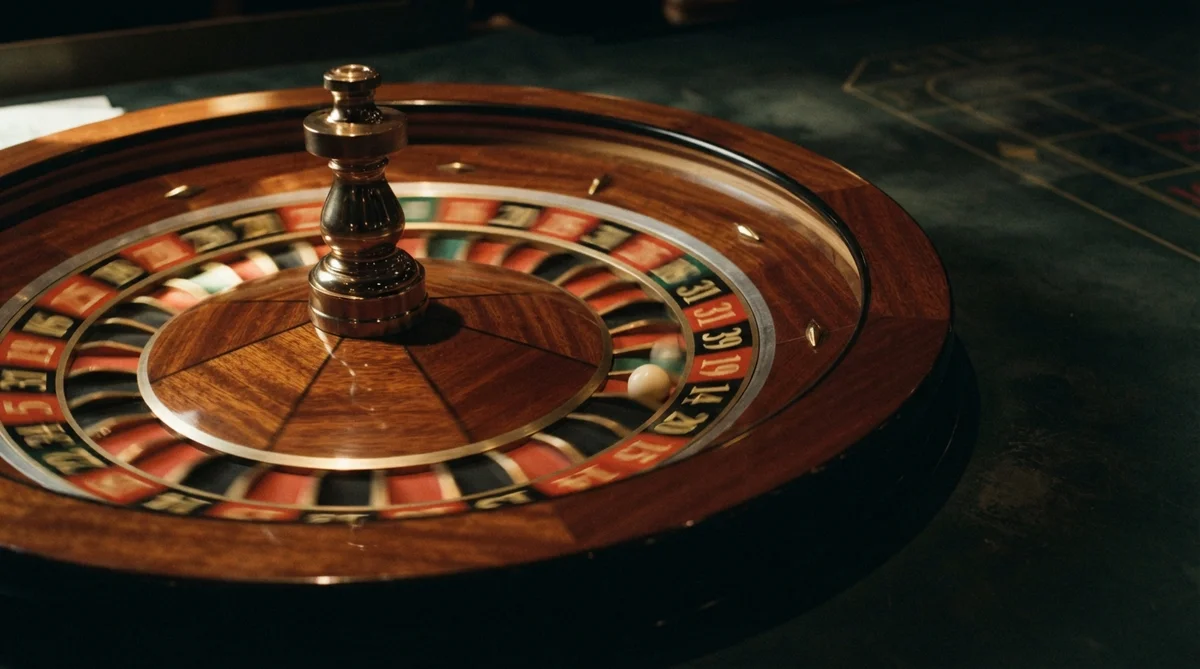
Probability describes how likely an outcome is under known conditions, while luck describes the result you happen to experience. A roulette number with a probability of 1 in 37 can appear on the next spin, but that single event does not change its probability on future spins.
Luck is therefore a description of observed results, not a force that changes the rules. Probability applies to the full set of possible outcomes, while luck is what you call an unusually favourable or unfavourable sample.
How Does Probability Work in Gambling?
Probability works by comparing favourable outcomes with all possible outcomes. In a simple fair die roll, the probability of a 6 is 1 in 6, or approximately 16.67%.
What Are Outcomes, Events, and Probability Spaces?
An outcome is one possible result, such as a red result in roulette. An event is a group of outcomes, such as any red number, and the probability space is the complete set of outcomes the game can produce.
These distinctions matter because different bets group outcomes differently. In single-zero roulette, red covers 18 of 37 pockets, so its probability is 18/37, or 48.65%, even though the payout is usually based on an even-money bet.
How Do Odds, Percentages, and Combinations Relate?
Odds can be written as fractions, percentages or ratios. A probability of 25% is the same as 1 in 4, while a probability of 2% is 1 in 50.
Card and lottery games often require combinations because the order or selection of items affects the number of possible results. OpenStax, the Rice University educational project, explains probability through sample spaces, counting methods and independent events, which are the same mathematical building blocks used in casino games.
How Do Luck, Randomness, and Variance Work?
Variance measures how widely actual results can move away from their average expectation. A high-variance game can produce large wins and losses around its long-term average, while a low-variance game tends to produce smaller fluctuations.
Why Can Short-Term Results Be Unusual?
Short samples are noisy. If a fair coin is tossed 10 times, 7 heads is entirely plausible even though the long-run expectation is 50% heads.
The same principle applies to gambling. A player can win several sessions in a row in a game with a negative expected value, because probability does not prevent favourable short-term samples.
How Does Variance Create Winning and Losing Streaks?
Independent random events naturally form clusters. A roulette player might see several red results close together, but that sequence does not make black more likely on the next spin.
Variance becomes more visible when stakes increase. The same game can feel manageable at $1 per bet and financially severe at $100 per bet, even though the underlying probabilities are unchanged.
What Is Expected Value Over Time?
Expected value is the average result predicted by probability across a very large number of comparable bets. It is not a promise about your next bet or your next session.
How Do You Calculate Expected Value?
Multiply each possible outcome by its probability, then add the results. For a $10 even-money bet with a 48.65% chance of winning and a 51.35% chance of losing, the expected value is:
(0.4865 × $10) + (0.5135 × -$10) = -$0.27
That is the approximate expected loss per $10 bet on an even-money single-zero roulette wager. The equivalent house edge is about 2.70%, with figures checked in August 2026.
Why Does a Big Win Not Mean a Profitable Game?
A large win is a realised outcome, not proof of positive expected value. If you make 100 bets and finish ahead, the session was profitable, but the game may still have offered a negative expectation.
Investopedia’s casino-odds analysis states that more play generally increases exposure to the house advantage. More bets can increase the chance of a temporary win, but they also increase the amount exposed to a negative average return.
What Are House Edge and Casino Game Odds?
House edge is the percentage of wagers the operator expects to retain over time, before tips, taxes or other costs. The figures below are representative mathematical values, not guarantees for every table, rule set or machine, and were checked in August 2026.
| Game or bet | Typical example | Approximate house edge | What changes it |
|---|---|---|---|
| Roulette | Single zero, even money | 2.70% | Double-zero wheels raise it to about 5.26% |
| Blackjack | Favourable rules, basic strategy | About 0.5% | Rules, number of decks and player decisions |
| Craps | Pass line | About 1.41% | Bet selection and odds wagers |
| Slot machines | Machine-dependent | About 2% to 50% | Paytable, denomination and game design |
| Sports betting | Standard two-way market | Market-dependent | Vig, price, limits and market efficiency |
What Is the House Edge on Roulette?
Single-zero roulette gives the house an edge of about 2.70% on standard outside bets because 18 winning pockets are opposed by 19 losing pockets. Double-zero roulette has 38 pockets and an edge of about 5.26% on the same type of bet.
How Does Blackjack Probability Change?
Blackjack can offer a relatively low house edge when rules are favourable and you use mathematically correct decisions. The result changes with deck count, blackjack payout, dealer rules, doubling restrictions, surrender options and side bets.
Which Craps Bets Have Lower Odds?
The pass line has an approximate edge of 1.41%, while don’t pass is about 1.36% under common rules. Free odds bets can carry no house edge on the odds portion, but they do not remove the edge on the associated pass-line or don’t-pass wager.
Why Do Slot Machine Odds Vary So Widely?
Slots use a paytable and a random number generator (RNG) to determine outcomes. Return to player (RTP) describes the theoretical amount returned over a large number of spins, while volatility describes how unevenly those returns arrive.
How Does Sports Betting Include a House Advantage?
Sportsbooks build an implied margin, often called the vig or overround, into prices. A market can appear to offer a 50% chance on each side while the combined implied probabilities exceed 100%, creating the operator’s margin.
Why Does the Law of Large Numbers Usually Favour the House?
The law of large numbers says that average results tend to move closer to their expected value as the number of trials grows. It does not say every player must lose in a fixed number of bets.
For the casino, thousands of bets reduce the effect of individual winners and losers. If the game has a 2% edge and total wagering reaches $1,000,000, the theoretical gross advantage is approximately $20,000, although actual results can vary.
What Are Common Probability Mistakes in Gambling?
What Is the Gambler’s Fallacy?
The gambler’s fallacy is the belief that a random outcome becomes more likely because its opposite has appeared repeatedly. Ten black roulette results do not make red more likely on the next independent spin.
What Are the Hot-Hand Fallacy and Due Outcomes?
The hot-hand fallacy treats a winning streak as evidence that the next win is more likely. The opposite claim, that a player or number is due to lose, makes the same error in reverse unless the events are genuinely dependent.
What Is Law of Small Numbers Bias?
Law of small numbers bias occurs when you treat a short sample as representative of the long-run distribution. A slot can return more than its theoretical RTP over 100 spins, but that does not establish its true return or predict the next spin.
Can Patterns or Betting Systems Beat Luck?
Betting systems cannot remove a built-in house edge from independent casino games. Progression systems change the size and timing of wagers, not the probability of the underlying outcomes.
For example, doubling after losses can exhaust a bankroll during a losing sequence, while table limits restrict how long the progression can continue. Roulette systems also cannot predict the next independent spin.
How Do Random Number Generators Affect Game Fairness?
An RNG produces the random sequence used by many digital casino games, but fairness depends on implementation, testing, game rules and the published paytable. A random outcome can still come from a game with a negative expected value.
The National Institute of Standards and Technology (NIST) publishes testing and statistical guidance relevant to random-number generation. When assessing a digital game, look for transparent rules, an independently tested RNG and a stated RTP, while remembering that testing does not change the house edge.
How Can You Manage Variance With Bankroll and Bet Size?
Bankroll management cannot create a mathematical edge, but it can limit the size and duration of losses. Use a fixed entertainment budget rather than money needed for rent, bills or debt payments.
- Set a session loss limit before play and stop when it is reached.
- Keep each stake small relative to the total budget, such as 1% or less per bet when variance is high.
- Do not increase stakes to recover losses or borrow money to continue.
- Record deposits, withdrawals and time spent so the actual cost is visible.
These are general safeguards, not personalised financial advice. If gambling is affecting bills, relationships or control over spending, use a self-exclusion service or speak with a qualified support professional.
Can Skill Create an Edge?
Skill can improve decisions in games where decisions affect expected value, but it does not guarantee a profitable result. Blackjack basic strategy can reduce the house edge, while poker involves opponents and may allow a skilled player to have a positive expectation before fees.
Skill has less influence in slots, roulette and most house-banked baccarat bets. Separate decision quality from outcome quality: a correct decision can lose, and a poor decision can win.
How Should You Interpret Winning and Losing Streaks?
Interpret a streak as a sample, not as evidence that the odds have changed. Ask whether the bets were independent, how many trials occurred, what the house edge was and how much was staked.
A useful record includes bet type, stake, result and session length. Avoid changing a strategy solely because of a short streak, and never treat a loss as evidence that a win is imminent.
How Can You Keep Responsible Gambling Expectations Realistic?
Gambling is entertainment with a measurable cost, not a reliable income source. Set both money and time limits, avoid play when distressed or intoxicated, and treat every advertised return as theoretical unless the terms clearly state otherwise.
- Use deposit, loss and time limits where available.
- Keep gambling separate from essential spending and credit.
- Take a break if you chase losses, hide activity or repeatedly exceed limits.
- Contact a qualified gambling-support service if stopping feels difficult.
The National Council on Problem Gambling advises seeking support when gambling causes financial, emotional or relationship harm. Rules, tools and support contacts vary by jurisdiction, so re-check them in August 2026 before relying on a specific service.
What Are the Frequently Asked Questions About Probability and Luck in Gambling?
Does Playing More Improve Your Chance of Winning?
Playing more gives you more opportunities to experience a win, but it also increases the amount wagered and your exposure to the house edge. It does not improve the expected value of a negative-return game.
Can Luck Change the Probability of the Next Bet?
No. In an independent game, previous wins and losses do not alter the next probability. A genuine change in rules, deck composition or market price can change the maths, but luck alone cannot.
What Is the Difference Between Chance and Skill?
Chance refers to uncertainty in the outcome, while skill refers to decisions that can influence available outcomes or expected value. Poker has a larger skill component than roulette, but short-term poker results still contain substantial variance.
Is It Possible to Win Consistently?
Some players can win over selected periods, and skill may produce a positive expectation in specific settings. For ordinary casino games with a house edge, consistent long-term profit is not a realistic expectation without an independently verified advantage, and no betting system changes that fact.