
AT A GLANCE
Standard poker hands are evaluated on a strict 10-tier hierarchy where a royal flush ranks highest and a high card ranks lowest. Having poker hand rankings explained simply comes down to understanding that rarer five-card combinations always defeat more common ones, regardless of suits.
- 10 discrete tiers govern standard traditional poker hands across variants like Texas Hold’em and Omaha.
- 5 cards always make up your final hand, selected from available hole cards and community cards.
- 0 ranking distinction exists between suits in standard card evaluation rules.
- 1 kicker card or more frequently decides pot distribution when two players share identical primary combinations.
The exact winning power of a hand depends on whether you play standard high-poker rules or alternative variants like Short Deck and Lowball.
How Are Poker Hand Rankings Explained from Best to Worst?
In standard card games, every five-card poker hand falls into one of 10 categories. The mathematical rarity of a card combination directly dictates its position on the hierarchy. Understanding this structure prevents costly misreadings during live or online play.
Below is the standard hierarchy used across standard poker variants. Reviewing how individual holdings compare ensures you can quickly assess table strength at The House Edge.
| Rank | Hand Name | Description | Example |
|---|---|---|---|
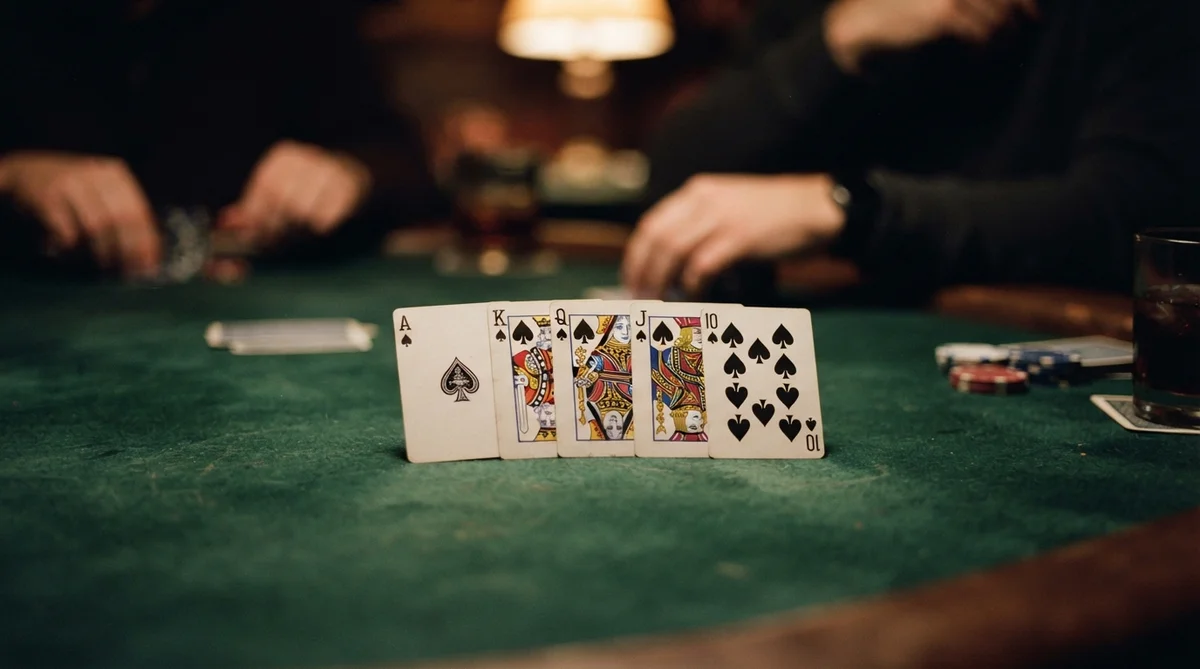
| 1 | Royal Flush | A, K, Q, J, 10 of the same suit | A♠ K♠ Q♠ J♠ 10♠ |
| 2 | Straight Flush | Five consecutive cards of the same suit | 9♣ 8♣ 7♣ 6♣ 5♣ |
| 3 | Four of a Kind | Four cards of matching numerical rank | 8♥ 8♦ 8♠ 8♣ K♦ |
| 4 | Full House | Three of a kind combined with a pair | J♠ J♦ J♣ 4♥ 4♠ |
| 5 | Flush | Five cards of the same suit in any order | K♦ J♦ 8♦ 4♦ 3♦ |
| 6 | Straight | Five consecutive cards of mixed suits | 10♥ 9♣ 8♦ 7♠ 6♥ |
| 7 | Three of a Kind | Three cards of matching numerical rank | 7♦ 7♠ 7♣ Q♥ 2♠ |
| 8 | Two Pair | Two distinct pairs of matching ranks | Q♠ Q♦ 9♣ 9♥ 5♠ |
| 9 | One Pair | Two cards of matching numerical rank | 1010♦ A♠ 8♣ 3♥ |
| 10 | High Card | No matching ranks or shared attributes | A♦ J♣ 8♠ 5♥ 2♦ |
What Is the Detailed Breakdown of Every Poker Hand?
Evaluating poker hands accurately requires understanding how each tier is composed. Every valid combination consists of exactly five cards, even when played in seven-card game formats.
1. What Is a Royal Flush?
A royal flush represents the strongest possible hand in standard high-card poker formats. It contains an Ace, King, Queen, Jack, and 10 of identical suit. Because suits hold equal status, two players holding royal flushes in separate suits would split the pot equally.
2. What Is a Straight Flush?
A straight flush consists of five sequential cards belonging to the same suit. An example is 9-8-7-6-5 all in hearts. If two players hold straight flushes, the hand topped by the higher card wins.
3. What Is Four of a Kind?
Four of a kind, often referred to as quads, contains four cards of identical rank accompanied by a fifth card known as the kicker. For instance, holding four Jacks along with a 7 creates four of a kind. Higher-ranked quads easily defeat lower-ranked quads regardless of kicker value.
4. What Is a Full House?
A full house combines three cards of one matching rank with two cards of another matching rank. When two players present full houses, the player with the higher-ranked three-of-a-kind combination wins the pot. For example, three Kings and two 4s beats three Queens and two Aces.
5. What Is a Flush?
A flush features five cards of identical suit that do not sequence in numerical order. When comparing competing flushes, the card with the highest single value determines the winning hand. If both high cards match, comparisons proceed down to the fifth card.
6. What Is a Straight?
A straight contains five cards in numerical sequence across multiple suits. Ace can act as either the highest card in an A-K-Q-J-10 straight or as the lowest card in a 5-4-3-2-A straight. A sequence capped by a higher card always defeats a lower sequence.
7. What Is Three of a Kind?
Three of a kind includes three cards of matching rank alongside two unmatched kickers. In community card games, this hand is called a set when made with a pocket pair and one board card. It is referred to as trips when made with two board cards and one hole card.
8. What Is Two Pair?
Two pair consists of two separate sets of matched cards alongside a fifth kicker card. An example is holding two Kings, two 8s, and a 4. If two players have two pair, the user with the higher top pair takes the pot.
9. What Is One Pair?
One pair contains two cards of equal numerical value and three unrelated kicker cards. Matching pairs of 10s beat matching pairs of 7s. When players share the exact same pair rank, kickers break the tie in descending order.
10. What Is High Card?
High card occurs when a hand fails to form any matching pairs, sequences, or flush combinations. The value of the single highest card evaluates the strength of the hand. If highest cards match, second-highest cards are compared down through all five slots.
How to Read Poker Hands and Break Ties
Tiebreaker mechanics resolve contested pots whenever two or more participants show hands from the same structural rank tier. According to standard tournament procedures verified by the Poker Tournament Directors Association, strict evaluation protocols govern these resolutions.
- Primary Tier Comparison: A higher hand category always defeats a lower category, meaning one pair of 2s defeats any high card combination topped by an Ace.
- Highest Rank Distinction: When players fall into the exact same category, card values determine the outcome, with Aces high down to 2s low.
- Descending Kicker Protocol: Unmatched side cards evaluate in descending order to decide hands that share identical main combinations.
What Is the Role of Kickers in Tiebreakers?
A kicker is an unused card within a five-card hand that breaks ties between hands of identical value. For instance, if Player A holds A-A-K-7-2 and Player B holds A-A-Q-J-9, both hold a pair of Aces. Player A wins because the King kicker beats the Queen kicker.
How Do Split Pots and Community Cards Work?
When five-card hands are identical across all slots, the dealer splits the pot evenly among winning participants. In community card games like Texas Hold’em, if the five board cards form the best combination for everyone, all active players split the pot regardless of hole cards.
What Are Real-World Hand Examples in Texas Hold’em?
Understanding hand strength requires seeing how hole cards combine with community board cards. In Texas Hold’em, players construct their best five-card hand out of seven available cards.
- Example 1 (Board: A♣ K♦ 10♠ 7♣ 2♦): Player A shows A♥ J♠ for a pair of Aces with a King-Jack kicker. Player B shows A♠ Q♦ for a pair of Aces with a King-Queen kicker. Player B wins the pot.
- Example 2 (Board: 8♠ 8♥ 4♣ 4♠ 2♦): Player A holds K♠ 2♣, forming Two Pair (Eights and Fours with a King kicker). Player B holds 10♦ 10♣, forming Two Pair (Tens and Eights with an Eight kicker). Player B wins because Tens beat Fours as the second pair.
- Example 3 (Board: Q♣ J♣ 10♣ 4♥ 2♦): Player A holds A♣ 5♣, making an Ace-high flush. Player B holds K♣ 9♣, making a King-high flush. Player A wins.
How Do Poker Hand Rankings Differ Across Variants?
While standard Texas Hold’em and Omaha share identical hand hierarchies, specific variants modify these rules to alter tactical dynamics.
- Deck Composition Rules: Stripping cards from a 52-card deck alters drawing probabilities and forces hierarchy realignments.
- Lowball Objectives: Games designed around lowest-value hands completely invert standard card hierarchy expectations.
- Split-Pot Structures: High-Low games split single pots between the strongest high hand and qualified low hands.
How Does Short Deck Hold’em Change Hand Order?
Short Deck Hold’em removes all 2s through 5s, leaving a 36-card deck. Because removal of low cards alters draw frequencies, a flush becomes harder to make than a full house. Consequently, in standard Short Deck rules, a flush ranks higher than a full house, and three of a kind often beats a straight.
How Do Lowball Games Handle Hand Rankings?
In lowball variants like Razz or Deuce-to-Seven Triple Draw, the lowest numerical hand wins. In Kansas City Lowball (2-to-7), straights and flushes count against you, making 7-5-4-3-2 of mixed suits the best possible hand. In A-to-5 lowball, straights and flushes are ignored, making 5-4-3-2-A the best holding.
What Are the Odds and Probabilities of Each Poker Hand?
Probabilities directly explain why hand tiers follow their specific order. Data published by the Center for Gaming Research at UNLV illustrates the exact mathematical occurrence of five-card holdings drawn from a standard 52-card deck.
| Hand Rank | Combinations | Probability (%) | Odds Against |
|---|---|---|---|
| Royal Flush | 4 | 0.000154% | 649,739 to 1 |
| Straight Flush | 36 | 0.00139% | 72,192 to 1 |
| Four of a Kind | 624 | 0.0240% | 4,164 to 1 |
| Full House | 3,744 | 0.1441% | 693 to 1 |
| Flush | 5,108 | 0.1965% | 508 to 1 |
| Straight | 10,200 | 0.3925% | 254 to 1 |
| Three of a Kind | 54,912 | 2.1128% | 46.3 to 1 |
| Two Pair | 123,552 | 4.7539% | 20.0 to 1 |
| One Pair | 1,098,240 | 42.2569% | 1.37 to 1 |
| High Card | 1,302,540 | 50.1177% | 0.99 to 1 |
Frequently Asked Questions
- Does a flush beat a straight? Yes, in standard high-card poker, a flush beats a straight because forming five cards of the same suit is mathematically rarer than five sequential cards.
- Does a full house beat a flush? Yes, a full house ranks higher than a flush in standard rules, occurring in only 0.1441% of random five-card hands compared to 0.1965% for flushes.
- What happens if two players have the exact same hand? If two players show identical hands including kickers, the dealer declares a split pot and divides the chips equally. Review local operator terms of use for specific house rules regarding odd chip distributions.
- Do suits rank higher than each other in poker? No, in standard poker rules, all four suits (spades, hearts, diamonds, and clubs) hold equal standing during hand evaluation.